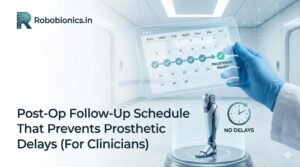
Post-Op Follow-Up Schedule That Prevents Prosthetic Delays (For Clinicians)
For many clinicians, the surgery is only the first step. What happens after the operation




Every amputee’s recovery story begins the same way — with hope, uncertainty, and a single question: When will I walk again?
For above-knee amputees, this question carries even more weight. Walking is not just about replacing what was lost; it’s about restoring rhythm, confidence, and safety. And that’s where microprocessor knees — the most advanced form of prosthetic technology — come into the picture.
For years, microprocessor-controlled knees (MPKs) were considered suitable only for highly active amputees or those who had already mastered basic walking with mechanical knees. But recent clinical research and real-world outcomes are challenging that belief. Many surgeons and physiatrists now ask an important question: Should microprocessor knees be introduced earlier?
Timing matters more than ever. Introducing an MPK too late can mean lost months of gait retraining, confidence, and fall prevention. Introducing it too early can overwhelm patients who aren’t physically or emotionally ready.
This article explores how physicians decide the right timing for MPKs — the clinical, physical, and psychological criteria that guide their judgment. We’ll also see how early introduction, when done right, can accelerate recovery, reduce fall risks, and improve quality of life dramatically.
Because sometimes, giving advanced technology sooner doesn’t just change how patients walk — it changes how they live.

A microprocessor knee, or MPK, isn’t just another mechanical joint. It’s a computer-controlled system that adjusts itself with every step. Inside the knee are sensors, microchips, and hydraulic systems that constantly monitor motion, speed, and terrain.
Unlike traditional prosthetic knees that depend solely on mechanical resistance, an MPK actively adapts to the user’s movement in real time. It can sense whether the person is walking on flat ground, stairs, or uneven surfaces — and instantly changes its resistance to keep balance steady.
The result feels smoother, safer, and more natural. Each step becomes predictable and confident, rather than calculated and cautious.
The true magic of an MPK lies in its sensors and algorithms. These tiny computers measure gait data hundreds of times per second — things like knee angle, stride speed, and pressure on the foot.
Using this data, the system automatically adjusts hydraulic resistance or swing phase to match the movement. It’s almost as if the prosthesis “thinks” with the user, anticipating each step instead of reacting to it.
For patients, this reduces the mental effort needed to walk. Instead of concentrating on every motion, they can walk more naturally, with less fatigue and more stability.
The timing of when to introduce a microprocessor knee can determine whether a patient adapts easily or struggles.
When introduced too early — before balance and muscle strength are ready — the patient might find it difficult to control the system effectively. When introduced too late, months of potential recovery and gait correction are lost.
Surgeons and physiatrists must therefore decide not just if a patient should get an MPK, but when. The right timing can accelerate progress and transform outcomes.
Traditionally, patients begin rehabilitation with mechanical knees, such as single-axis or polycentric systems. These are simple, reliable, and affordable — ideal for early mobility training.
Once patients gain strength and stability, doctors may then transition them to an MPK. The idea is to let them first master basic movement, then refine it with technology.
However, recent evidence suggests that this stepwise model might not always be necessary. Some patients benefit more when introduced to MPKs earlier, even in initial training.
The decision to fit a microprocessor knee early depends on teamwork. Surgeons handle the medical side — wound healing, limb alignment, and residual limb condition. Physiatrists oversee functional progress — balance, endurance, and emotional readiness.
Together, they assess when a patient is physically and psychologically prepared to handle a higher level of technology.
Early MPK adoption requires precise judgment, but when done right, it can fast-track rehabilitation and significantly reduce fall risk.
For years, MPKs were reserved for “high-functioning” amputees — typically younger, more active, and stronger patients. Doctors assumed that older or less mobile individuals wouldn’t gain enough benefit to justify the cost.
But clinical data over the past decade tells a different story. Even low-activity users — especially older adults or those with balance issues — show marked improvement in safety and confidence with MPKs.
The conversation has shifted from “Who qualifies for an MPK?” to “Who would benefit most, and when?”
Falls are one of the most common and dangerous complications for above-knee amputees. They cause injuries, fear, and even hospitalization.
Mechanical knees don’t adapt quickly when the user trips or shifts suddenly. MPKs, however, detect these micro-changes instantly. They activate “stance support,” locking the knee momentarily to prevent collapse.
For new amputees who are still learning balance, this feature can be lifesaving. Early exposure to an MPK teaches safer walking habits from the start.
Confidence plays a massive role in rehabilitation. Patients afraid of falling often move less, slowing recovery.
Introducing a microprocessor knee early can remove that fear. The knee’s intuitive response builds trust in movement, allowing patients to walk naturally without constant anxiety.
This emotional boost helps them engage more in therapy, leading to faster and more complete recovery.
Walking is partly mechanical, but mostly neurological. It’s about rhythm, timing, and automatic coordination — what doctors call motor learning.
When patients learn to walk using a mechanical knee, their brain adapts to that limited range of motion and manual control. Switching to a microprocessor later means relearning those patterns.
Introducing MPKs earlier, before habits are fully formed, helps build correct motor memory from the beginning. This can lead to smoother, more symmetrical gait in the long term.
While MPKs are more expensive upfront, early fitting can actually reduce long-term costs by preventing complications like falls or overuse injuries.
Patients who walk more confidently with MPKs tend to maintain better physical fitness and independence, requiring fewer medical interventions over time.
This makes early adoption not just a medical choice, but a practical and economic one.

The first factor surgeons consider is whether the residual limb has healed completely. Early prosthetic fitting, especially with an advanced knee, requires a stable limb without swelling, pain, or open wounds.
Soft tissue tolerance is also crucial. The limb must handle the pressure of the prosthetic socket without skin breakdown. If healing is incomplete, fitting an MPK too soon can lead to discomfort and poor alignment.
Once the limb is stable, doctors can safely explore advanced options.
Walking with a prosthetic knee demands strength from more than just the leg — it involves the entire core.
Physiatrists often test hip extensors, abductors, and trunk control. These muscles help control movement, maintain posture, and stabilize the body when walking.
If these areas are weak, doctors might recommend short-term strengthening therapy before fitting an MPK. The goal is to ensure the patient can control the device’s adaptive functions safely.
Before recommending an MPK, doctors use standard assessments like the Timed Up and Go (TUG) or Berg Balance Scale to measure coordination.
Patients who score within safe ranges are more likely to benefit from microprocessor control early on. Those who show instability might need basic gait training first.
These tests don’t just measure ability — they predict adaptability. If a patient demonstrates good control, early MPK fitting can be justified confidently.
While MPKs automate many walking adjustments, they still require understanding basic operation — charging the device, switching modes, or recognizing feedback signals.
Doctors assess whether the patient can follow instructions and manage the prosthesis responsibly.
Elderly users, for example, can do very well with MPKs when properly educated and supported, but only if they are comfortable with basic technology.
A short familiarization period can make even hesitant users comfortable with daily use.
An MPK offers advanced control, but it still demands moderate physical stamina. Surgeons and physiatrists evaluate cardiovascular health to ensure the patient can handle the increased walking volume that comes with confidence.
If endurance is low, structured physiotherapy helps build it before transitioning to a microprocessor system.
The goal isn’t to delay, but to prepare — ensuring the prosthesis enhances ability instead of overwhelming it.
Patients who lose limbs suddenly — often younger or more active individuals — tend to have strong motivation for rapid recovery. They usually adapt faster, making them excellent candidates for early MPK introduction.
For these individuals, early exposure to microprocessor control builds natural gait patterns quickly and minimizes energy waste during walking.
Contrary to older practices, even older patients benefit from early MPKs — especially those at risk of falls. The intelligent stance control helps prevent knee buckling, a common cause of falls among elderly amputees.
This stability encourages them to walk more often, which in turn maintains overall health and reduces frailty.
For patients missing both legs above the knee, coordination and stability become critical. Early MPK fitting can make rehabilitation safer and more manageable.
The adaptive control allows smoother transitions between sitting, standing, and walking, reducing the mental load on patients.
Individuals living in rural areas or uneven environments often face daily mobility challenges. Early MPK fitting provides them with terrain adaptability from the start, preventing early frustration and helping them maintain independence.

In prosthetic rehabilitation, the surgeon and the physiatrist are like two halves of a compass — one defines the body’s readiness, the other guides functional recovery.
Surgeons focus on medical and surgical healing. They assess whether the residual limb is healthy, well-shaped, and ready to bear pressure. Physiatrists look beyond the incision — at muscle strength, posture, coordination, and endurance.
Together, they create a full picture of readiness. Without this collaboration, early MPK fitting risks either being premature or unnecessarily delayed.
Surgeons evaluate limb condition meticulously. The shape and volume of the residual limb must be stable. Any fluctuation — swelling, scar tension, or neuroma pain — can make prosthetic fitting uncomfortable or risky.
They also assess bone alignment. A well-aligned femur ensures smooth load transfer through the prosthesis, reducing strain on the hip and lower back.
In early MPK cases, alignment accuracy becomes even more important because the technology depends on consistent mechanical symmetry to function properly.
Even the most advanced microprocessor knee won’t perform well if the socket isn’t fitted correctly. The socket is the connection point between the patient’s body and technology — it must fit perfectly, distribute weight evenly, and remain comfortable during long wear.
Surgeons and prosthetists often work together during this stage, ensuring the limb’s shape and tissue condition support a stable fit. Physiatrists then verify comfort and control during motion exercises.
Only when both medical and functional aspects align can an early MPK fitting move forward safely.
Physiatrists focus on how the patient interacts with their body and environment. They analyze standing balance, reaction speed, and muscle engagement.
Key tests like the Timed Up and Go (TUG), Berg Balance Scale, and Six-Minute Walk Test (6MWT) offer objective insight into functional potential.
If patients can transfer safely from sitting to standing, maintain posture for several minutes, and follow basic gait cues, they’re considered physically ready for a microprocessor system.
These assessments are not just technical — they’re predictive of long-term success.
Technology only works when the person using it feels confident. Physiatrists therefore pay close attention to emotional readiness.
Some amputees are eager to learn and adapt quickly. Others struggle with anxiety, fear of failure, or disbelief in their ability to use advanced prosthetics.
Through counseling and education, physiatrists help patients overcome hesitation. When fear fades, learning accelerates.
Cognitive readiness is also vital. Patients must understand how to maintain, charge, and operate the MPK correctly. A short orientation period before fitting often makes the transition seamless.
The first green light comes from surgical recovery. The wound must be fully healed, and the residual limb’s volume should be stable for at least a few weeks.
There should be no active infection, uncontrolled diabetes, or vascular issues that could affect circulation. Pain levels should also be low enough for comfortable prosthetic use.
Doctors emphasize that the patient’s general health — blood pressure, heart function, and stamina — must support walking activity before any advanced prosthetic system is fitted.
Before introducing a microprocessor knee, patients should demonstrate basic mobility skills like standing unsupported, balancing briefly, and walking short distances using support.
If these are achieved early, there’s no reason to delay fitting. In fact, the MPK can enhance confidence during this phase by offering better control and smoother gait mechanics.
Physiatrists observe how patients move. Are they symmetrical? Do they shift weight evenly? Are they dragging or overcompensating on one side?
These observations help determine readiness for MPKs. If gait symmetry and rhythm are moderately stable, early exposure to adaptive knee technology helps refine these mechanics faster than with mechanical systems.
Motivation can often outweigh physical limitations. A highly driven patient will put in extra effort to learn new systems and practice walking daily.
Doctors recognize this psychological factor as a major predictor of success. In many cases, patients with strong motivation adapt to MPKs earlier and achieve greater independence than expected.
An MPK user benefits greatly from a supportive environment — family members who encourage movement, access to safe walking spaces, and regular follow-ups.
Physiatrists assess the patient’s living situation before early fitting. If support systems are strong, early adoption becomes easier. The prosthesis becomes not just a device, but part of a routine supported by family and therapy networks.

The most immediate effect of early microprocessor fitting is psychological. Patients who experience the stability of an MPK early on lose fear faster. They trust their limb, walk more naturally, and engage better in therapy.
This trust shortens the adjustment phase dramatically. Instead of months of cautious walking, patients often achieve smooth motion within weeks.
Confidence leads to consistency, and consistency builds skill.
One of the most striking differences between mechanical and microprocessor knees is how naturally they allow users to walk. MPKs adapt hydraulic resistance during both stance and swing phases, encouraging smoother transitions.
When introduced early, patients learn correct gait mechanics from the start — maintaining even stride lengths, balanced posture, and reduced hip compensation.
Over time, this prevents joint strain, lower back pain, and muscle fatigue. Early MPK users often show more symmetrical movement patterns in long-term evaluations.
Walking with a prosthesis requires more energy than with two natural legs — sometimes up to 60% more for above-knee amputees.
MPKs reduce this demand by adjusting automatically to walking speed and terrain. Early introduction helps the patient experience efficient movement before developing compensatory habits that waste energy.
This efficiency is especially valuable for older or cardiac-compromised patients who need to conserve strength during daily activity.
Perhaps the greatest advantage of MPKs is their ability to prevent falls. The intelligent stance phase control detects when the knee is unstable — such as during uneven terrain or accidental stumbles — and locks momentarily to prevent collapse.
Early use means this safety feature is present from the beginning of rehabilitation. Instead of teaching patients to fear instability, it trains them to move confidently.
Research shows that early MPK users report fewer falls and greater activity levels within the first year of rehabilitation.
When an MPK is introduced early, patients maintain better activity levels over time. They stay mobile longer, avoid secondary health issues linked to inactivity, and rely less on caregivers.
In short, early fitting doesn’t just speed recovery — it changes the trajectory of independence for years to come.
Walking again after amputation is deeply emotional. For many, the moment they take a stable, natural step with an MPK marks the point where grief turns to hope.
By restoring natural movement early, these devices help patients reconnect with life faster. They can participate in social activities, return to work sooner, and rebuild confidence in their body.
This psychological recovery is as important as physical progress.
One of the biggest debates around early MPK fitting is cost. Microprocessor knees are more expensive than mechanical ones, which often makes doctors cautious about recommending them too soon.
However, long-term analysis shows that reduced fall risk, lower hospitalization rates, and faster rehabilitation offset much of the initial investment.
For patients who remain active for years, early MPKs often prove cost-effective in both medical and functional terms.
Some doctors worry that elderly or less tech-savvy patients might struggle to manage charging or operating an MPK.
In practice, most systems are designed for simplicity. Basic models require only one daily charge and have intuitive control buttons. Training sessions during rehabilitation ensure that even non-technical users adapt easily.
As familiarity grows, maintenance becomes routine rather than burdensome.
A few clinicians hesitate to introduce MPKs early, fearing the added weight might strain weak limbs. But modern devices are lighter than ever — with ergonomic designs that distribute load evenly.
Once balance and core strength are adequate, the additional weight becomes negligible compared to the stability benefits provided by the system.
It’s true that microprocessor knees require a short learning phase. Patients must get used to dynamic resistance and feedback patterns.
However, this learning phase is far shorter when introduced early — before the patient’s brain fully adapts to mechanical walking patterns.
Early exposure actually simplifies long-term learning and reduces the need for retraining later.
When surgeons and physiatrists decide whether to introduce a microprocessor knee early, they rely on both science and intuition.
Each patient’s situation is unique — age, cause of amputation, healing rate, and mental readiness all play major roles. But clear guidelines help ensure that decisions are consistent, evidence-based, and patient-centered.
Early MPK fitting should always follow a principle: technology should match capability, not overwhelm it.
At this stage, the surgeon ensures the residual limb is structurally and medically sound. Healing must be complete, circulation adequate, and skin healthy.
If there’s edema, scarring, or pain that might affect socket comfort, the surgeon delays fitting slightly until these stabilize.
However, if healing is smooth and the patient demonstrates good wound tolerance, early fitting can safely begin within the first few months post-surgery.
Physiatrists use simple tests to confirm readiness for MPK control — the ability to stand without excessive sway, maintain balance for at least 30 seconds, and perform short-distance walking using parallel bars or aids.
If these conditions are met, early fitting becomes more beneficial than waiting. The prosthesis can then serve as both a walking aid and a rehabilitation tool, helping build strength through movement.
Even the most advanced prosthesis is ineffective if the patient fears it. Emotional readiness is therefore a key factor.
Before fitting, doctors ensure that the patient understands what to expect — how the knee will move, what feedback it gives, and how to trust its automatic control.
Once patients feel confident rather than anxious, their learning curve becomes much faster.
The environment also matters. Does the patient have access to follow-up therapy? Are they surrounded by supportive family members who encourage mobility?
If these elements are in place, early MPK use becomes smoother and safer. Rehabilitation isn’t a solo process — it’s built on a network of care that reinforces progress every day.
Finally, doctors and patients must agree on goals. Early fitting isn’t about turning someone into a marathon walker; it’s about helping them move safely, confidently, and independently in their environment.
When expectations are realistic, satisfaction levels remain high — and rehabilitation feels rewarding rather than frustrating.

A 55-year-old patient with a transfemoral amputation due to diabetes presents with good wound healing but weak core strength. Traditionally, such a patient might start with a mechanical knee.
However, the physiatrist notes good cognitive awareness and motivation. With a few weeks of strengthening therapy, the team introduces an MPK early.
Within two months, the patient reports fewer stumbles and increased walking distance. The technology’s stability allows him to regain confidence faster than expected.
This case shows that even patients with comorbidities can benefit from early MPK introduction when criteria are carefully followed.
A 30-year-old trauma survivor, previously athletic, receives an above-knee amputation. From day one, he is motivated to return to work and active living.
Given his endurance and strength, surgeons approve early MPK fitting within weeks of wound healing. The result is a seamless adaptation — smooth gait, stable running, and rapid return to function.
In such cases, early exposure to adaptive control prevents the need for later retraining and supports a more natural walking rhythm from the start.
An older patient, aged 70, presents with mild frailty and anxiety about falling. Mechanical knees would typically be the conservative choice.
But given her high fall risk, physiatrists decide to introduce a stance-control MPK early. The device’s micro-stability system prevents knee collapse, allowing her to walk confidently with a cane.
Within weeks, she begins moving around the home independently — something her family thought impossible.
This case proves that early fitting can be justified even for low-mobility seniors when fall prevention is a major goal.
One of the hidden challenges in prosthetic rehabilitation is overuse injuries on the sound limb.
When patients walk with mechanical knees that don’t adapt well, they unconsciously overuse the healthy leg to maintain balance. Over time, this leads to joint strain, hip pain, and even arthritis.
Early MPK fitting corrects this imbalance early. Because gait is smoother and more symmetrical, both sides of the body share the load naturally.
Early mobility supported by MPKs keeps patients active and prevents sedentary complications such as heart disease, obesity, and muscle loss.
The less energy a person spends per step, the longer they’re willing to walk. This improved efficiency transforms rehabilitation into lifestyle — movement becomes second nature again.
Mobility doesn’t just restore the body — it restores life.
Patients who walk confidently attend social events, go shopping, visit family, and participate in activities they once avoided. Early MPK use accelerates this reintegration process.
Many physiatrists note that early mobility leads to measurable improvements in mental health, reduced depression scores, and higher self-esteem.
When advanced prosthetics are introduced early, patients learn correct gait mechanics from the start. Their nervous system, posture, and coordination evolve around natural movement patterns.
This creates a lifelong foundation for efficient walking and minimizes the need for complex gait retraining later.
The earlier correct mechanics are established, the longer their benefits last.

For many Indian patients, access to microprocessor knees has long been limited by cost. Imported models can exceed ₹10 lakh, putting them beyond the reach of most families.
RoboBionics was founded to close that gap — by creating advanced, world-class prosthetics made right here in India at a fraction of the cost.
With 60 of our 64 components manufactured locally, we’ve reduced costs to between ₹2.15–3 lakh, without compromising on quality or precision.
This affordability means more doctors can now recommend early MPK fitting based on medical criteria rather than financial constraints.
Our approach is built on partnership. We work closely with surgeons and physiatrists to understand patient needs, assess readiness, and tailor prosthetic solutions accordingly.
By sharing data from objective outcome measures — such as AMPnoPRO, 6MWT, and TUG — we help physicians make evidence-based decisions about timing and technology.
This collaboration ensures that every recommendation is not just clinically justified but also achievable for the patient.
Our prosthetic systems, including microprocessor knees and the Grippy™ Bionic Hand, are engineered for Indian lifestyles — durable, lightweight, and easy to maintain.
They handle varied terrains, weather conditions, and activity levels with stability and comfort.
For doctors treating patients from diverse backgrounds — from urban professionals to rural farmers — this reliability means early fitting can be done confidently, knowing the device will perform in real conditions.
RoboBionics doesn’t stop at manufacturing. We train both medical professionals and users in handling our devices safely and effectively.
For early MPK adopters, our rehabilitation partners provide guided walking sessions that help patients learn balance, control, and trust in the device.
This approach reduces the learning curve and ensures that early fitting always leads to safe, successful use.
We’re also building a network of feedback systems across partner clinics to track real-world outcomes. Every patient fitted with our technology contributes anonymous data that helps refine design and training programs.
By analyzing improvements in walking distance, balance, and fall rates, we continuously improve both products and rehabilitation methods.
This focus on measurable outcomes sets a new benchmark for prosthetic care in India — one rooted in data, compassion, and collaboration.
Historically, prosthetic care in India followed a reactive approach — fit first, measure later. But the future belongs to proactive, predictive medicine.
When doctors use clear criteria to justify early MPK fitting, they prevent complications instead of treating them later.
This shift from reaction to prevention represents a new era in rehabilitation — one that prioritizes timing as much as technology.
For many Indian clinicians, exposure to advanced prosthetic technologies is still growing. Workshops and training sessions, like those conducted by RoboBionics, bridge this knowledge gap.
When more surgeons and physiatrists understand how to evaluate readiness and justify timing, early MPK adoption will become standard practice rather than an exception.
With innovation, affordability, and education coming together, early MPK fitting has the potential to become the new normal in India.
Patients won’t have to wait months or years to experience natural, safe walking. Doctors will have both the tools and confidence to act early — transforming lives faster.
The question isn’t whether a microprocessor knee is right — it’s when it’s right.
When introduced too late, opportunity is lost. When introduced too early without preparation, progress can stall. But when timing is perfect — when medical readiness meets motivation, and technology meets trust — the results are extraordinary.
Surgeons and physiatrists hold the key to this balance. Their combined judgment determines not only how well patients walk, but how quickly they reclaim their lives.
At RoboBionics, we believe that every patient deserves timely access to world-class prosthetics — guided by science, delivered with care, and supported by affordability.
If you’re a clinician, rehabilitation specialist, or healthcare provider ready to explore advanced prosthetic timing for your patients, we invite you to collaborate with us.
Book a consultation or demo at robobionics.in/bookdemo — and together, let’s make early mobility a reality for every amputee in India.
Because timing doesn’t just shape recovery — it defines freedom.
For many clinicians, the surgery is only the first step. What happens after the operation
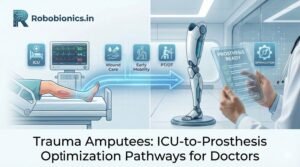
For trauma amputees, the journey does not begin at the prosthetic clinic. It begins much
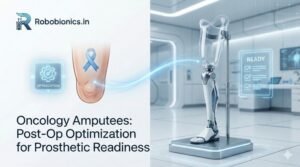
Amputation after cancer is not just a surgical event. It is the end of one
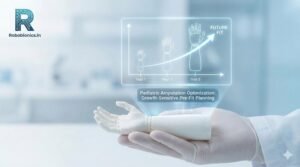
When a child loses a limb, the challenge is never only physical. A child’s body